21st April 2026
When Social Contract Meets Social Licence
A Framework for Organisations That Want to Earn Trust, Not Just Claim It
There is a concept most leaders know instinctively but rarely articulate precisely: the idea that an organisation’s licence to operate depends not just on what it produces, but on how it treats the people inside it and the communities around it.
What is less well understood is that these two obligations are structurally linked, and that managing one without the other is not just incomplete strategy, it is a form of institutional risk.
This piece introduces a framework for thinking about both obligations together: the Social Contract and the Social Licence, and why the relationship between them matters more than either one alone.
Two Constructs, One System
“The strongest is never strong enough to be always the master, unless he transforms strength into right, and obedience into duty.”
Jean-Jacques Rousseau, Du Contract Social, 1762
The Social Contract:
In the corporate context, is the unwritten reciprocal agreement between an organisation and its people.
It is not the employment contract. It is the deal beneath the deal: what the organisation genuinely offers its people in exchange for their discretionary effort and commitment.
In my own work, I describe this through what I call the Four As of Mutual Obligation. Organisations offer Authority (decision-making power) and Autonomy (freedom over how outcomes are achieved), and in return they expect Agency (the genuine exercise of one’s full capability in service of the work) and Accountability (ownership of results, including the willingness to learn from failure rather than deflect, defer, defend or deny).
When this contract is functioning, people feel genuinely empowered. When it breaks down, you get performative compliance, political self-protection, and the quiet erosion of trust.
“The only purpose for which power can be rightfully exercised over any member of a civilised community, against his will, is to prevent harm to others.”
John Stuart Mill, On Liberty, 1859
The Social Licence:
Is the organisation’s unwritten permission to operate, granted not by regulators but by the communities, customers, employees and broader society that the organisation affects.
It covers the products an organisation sells, the means by which it sells them, and the impact it has on the world around it. It is what ESG frameworks are attempting to codify, though the licence itself predates any reporting standard and cannot be fully captured by one.
Like the Social Contract, it is:
- Unwritten
- Relational
- Revocable
Often without warning.
Shared Characteristics: Why Both Are Often Mismanaged
Both constructs share three defining characteristics that most leaders fail to reckon with simultaneously:
- They are unwritten, meaning no document fully captures them
- They are relational, meaning they exist in the perception of others, not in the intentions of management
- They are revocable, meaning they can be withdrawn faster than they were built
The Two-by-Two: Four Organisational Archetypes
Plotting these two constructs against each other produces four distinct organisational archetypes, each with its own failure mode and its own intervention logic.
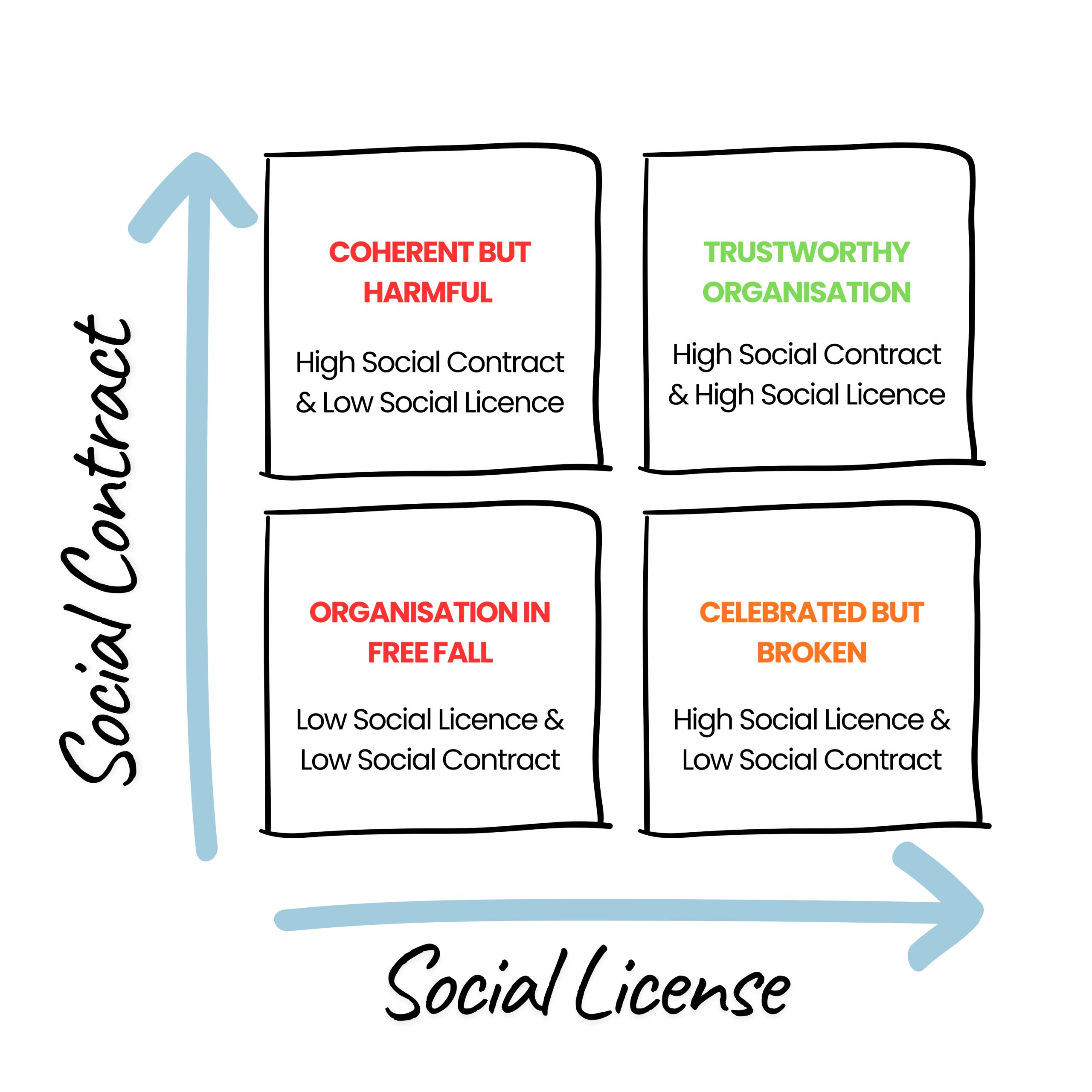
Trustworthy Organisation (High Social Contract / High Social Licence)
- This is the archetype most boards believe they occupy and most do not.
- The internal deal is genuine: people are empowered, accountable, and operating with real Agency. The external deal is equally genuine: the organisation’s products, conduct, and community impact reflect values that are lived rather than reported.
- This is the only quadrant that is structurally stable over time.
Coherent but Harmful (High Social Contract / Low Social Licence)
- The internal culture may be excellent. People are empowered and accountable. The Four As are functioning.
- But the external impact, whether through the product itself, the supply chain, the environmental footprint, or the community relationships, is eroding trust.
- This is the most counterintuitive and, I would argue, the most dangerous quadrant.
- Internal coherence can accelerate external harm. A highly engaged, high-Agency workforce executing a harmful strategy does so efficiently.
- The tragedy of this quadrant is that good people, operating under a functioning Social Contract, can collectively produce outcomes that breach the Social Licence, and they rarely see it coming.
Celebrated but Broken (Low Social Contract / High Social Licence)
- Externally, it is admired. It wins sustainability awards. Its purpose narrative is compelling. Its stakeholder communications are polished.
- Internally, it is a different story: people are burnt out, disempowered, and operating in a culture where Accountability is demanded but Authority and Autonomy are withheld.
- This is increasingly common in mission-driven sectors: NGOs, purpose-led consumer brands, parts of the technology industry.
- The external narrative masks internal dysfunction until something forces it into the open, usually a wave of attrition, a whistleblower, or a public culture reckoning.
Organisation in Free Fall (Low Social Contract / Low Social Licence)
- Neither its people nor its communities trust it.
- The failure modes here are not sequential, they are simultaneous: regulatory scrutiny, talent exodus, customer defection, and reputational collapse tend to converge.
- The consulting question in this quadrant is not whether to act but in what order, and the answer is almost always to stabilise the internal contract first, because you cannot credibly ask people to serve communities they are not themselves trusted to serve.
The Sequence Argument: Why Order Matters
There is a sequencing logic here that challenges current boardroom orthodoxy.
The dominant instinct when organisations feel their Social Licence under pressure is to invest in external stakeholder engagement: better ESG reporting, more community investment, improved customer communications.
These are not wrong, but they are often premature.
The Social Contract must precede the Social Licence in any genuine transformation, because values cannot be exported before they are lived.
You cannot ask a workforce operating under a broken internal contract to credibly embody the organisation’s values in their customer interactions, community relationships, or supply chain decisions.
The internal deal sets the ceiling for the external deal.
The Feedback Loop: How the Two Systems Reinforce Each Other
There is also a feedback loop that runs in the other direction.
The Social Licence shapes the context in which the Social Contract is negotiated.
Talented people, particularly those with choices, increasingly select employers based on external licence factors: the impact of the product, the ethics of the business model, the organisation’s standing in the community.
A weakening Social Licence therefore makes it progressively harder to attract the people who will bring genuine Agency and Accountability to the work.
The two systems are not independent. They reinforce and undermine each other in ways that compound over time.
What Leaders Should Do with This
The practical implication is straightforward, even if the execution is not.
Leaders should be conducting an honest diagnostic of both obligations simultaneously, not in separate workstreams managed by HR and the Sustainability team respectively, but as a single question:
Where are we on this matrix?
And more importantly:
What does the gap between our internal and external social health tell us about our actual strategy, as opposed to our stated one?
A few diagnostic questions are worth sitting with:
- Do the people inside this organisation feel genuinely empowered to make decisions, or do they escalate everything and call it collaboration?
- When things go wrong, is the first instinct to own it or to manage the narrative?
- Does the organisation’s external ESG posture reflect decisions that were actually difficult to make, or reporting that was relatively easy to produce?
- Would the communities, customers and suppliers this organisation depends upon describe the relationship as genuinely reciprocal?
The answers to these questions will locate you on the matrix more reliably than any engagement survey or materiality assessment.
The Point: This Is a Leadership Discipline
Both the Social Contract and the Social Licence are unwritten, relational, and revocable.
Most organisations manage them separately, in different teams, with different vocabularies, on different reporting cycles.
The ones that manage them as a system, understanding that the internal deal sets the foundation for the external one, and that both are simultaneously at risk, are the ones that earn the right to the top-right quadrant.
That is not a positioning exercise.
It is a leadership discipline.

Justin Miles
Categories: Designing Organisations Developing Leaders General